



































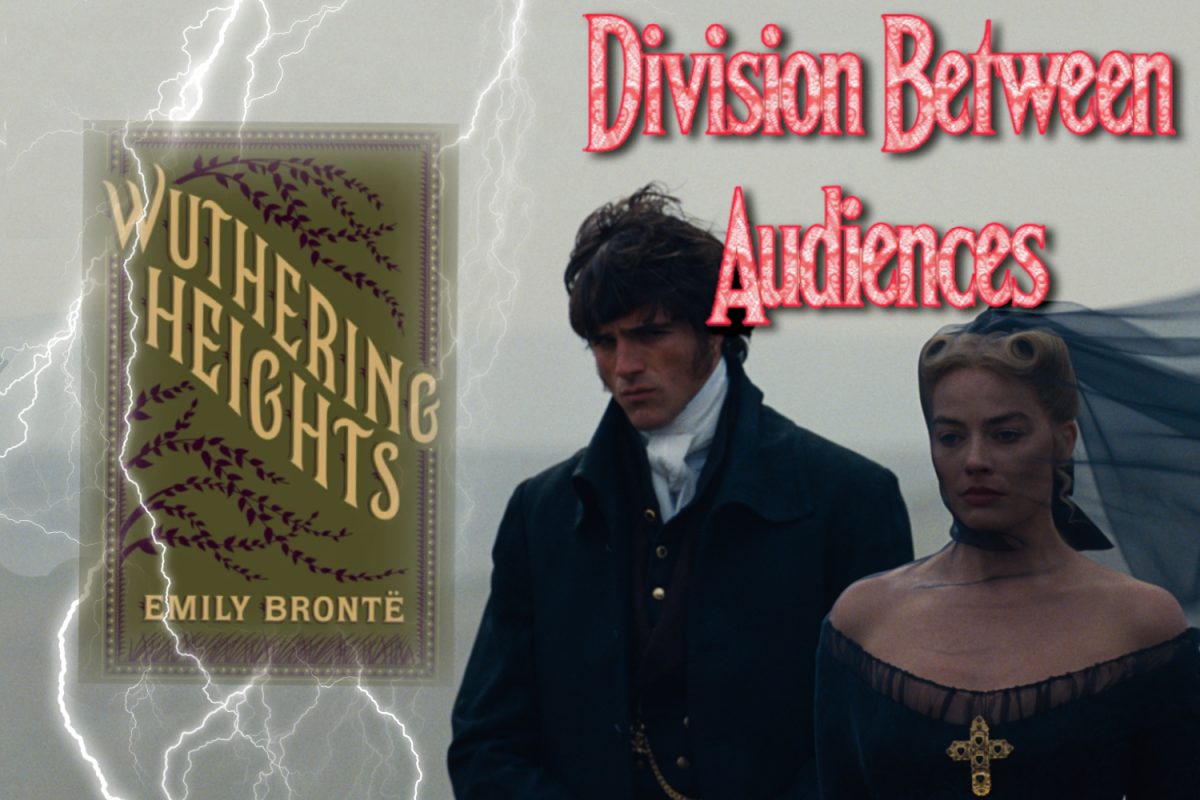
Wuthering Heights, released on Feb. 13, served as a metaphor: like a bird in a cage, you can become trapped by intoxicated love. With Heathcliff and Catherine’s volatile destinies, their relationship was bound to be condemned.
Looking beyond their facades, they still loved each other as much as ever, despite their inner demons. However, this gothic romance piece has raised varying opinions from audiences, primarily due to major differences between this year’s film adaptation and the novel by Emily Brontë.
Emerald Fennell, the director of the latest adaptation, had a strong connection to the book, explaining that she chose to create her own ‘version’ of the story, rather than directly mirroring it in her film. However, this drew strong backlash from viewers, especially regarding Heathcliff, portrayed by Jacob Elordi, and his skin tone.
In the book, Brontë describes Heathcliff as a gypsy-like man with darker-toned skin and dark hair. Although his ethnicity remains an enigma, these adjectives were disregarded when Elordi was cast.
This casting essentially ignored the plotline involving Heathcliff’s jealousy towards Edgar Linton, which stemmed from Linton’s fair skin and light hair. As opposed to the book, Fennel placed emphasis on love beating a class system through a tragic and passionate story.
Sophomore Emma Estevez states, “I feel like Emerald Fennell’s interpretation of the story was disrespectful and sexualizing. It [the movie] should have stayed true to the story, but I still think it came out very beautiful and engaged me throughout the movie.”
The adaptation also widely shocked the audience, sending giggles, gasps, and shrieks throughout each theater. One of the most twisted scenes, in which Isabella was tied to Heathcliff like a rabid animal, was interpreted in several ways. Both interpretations landed on the same side, calling the scene appalling, fetishizing, and sickening.
Junior Jada Cooper explains, “A movie is obviously going to have differences from a book. I think the scenery and overall plot should be similar, but the things they [the characters] say and the way they act can be different.”
While comparisons between the book and the movie rose, Wuthering Heights also sparked conversation about modern relationships. Some recommended the film as an ideal date for Valentine’s Day, yet it backfired strongly on the man in the relationship.
Videos on social media blew up with captions like, “Me after watching Wuthering Heights with my boyfriend [or husband],” while giving them a dirty look. This made women in relationships feel like men in this generation no longer go to great lengths for love. Heathcliff’s adoration and yearning for Catherine set a higher standard for females, leaving them disappointed with their current relationships.
Wuthering Heights forced Elordi to try out the Yorkshire accent, and some even said it was hard to understand the words he was articulating. Elordi says in an interview when he was asked about the difference between filming in Australia and in Yorkshire, “It’s different. It’s quite different, climate-wise.” He continues, “I just practiced it in the bath over and over and over and over. No, but I like the meks and the teks, instead of take, you know.”
Ultimately, Emerald Fennell’s adaptation of Wuthering Heights strongly divided the audience in half. While some members of the audience admired the passion and intense performance, the other half felt it fell short of the book’s expectations.
The audience’s reaction to casting choices and controversial scenes demonstrates the attachment some have to a classic story. Many believe that a film’s opinion should not divide the audience in half but help them bond.
Junior Jada Cooper notes, “A movie is obviously going to have differences from a book. I think the scenery and overall plot should be similar, but the things they [the characters] say and the way they act can be different.”