



After school and other events, eventually all lives are led back home. Home is usually not a place, but often the people surrounding us. Blood-related or not, the closer an individual gets to someone, the more they feel them. Their love and pain become your own. Unfortunately, an obstacle like a disability can magnify that pain in a loved one. To simplify the concept, they are the battery powering your light. However, when you start to see their battery deteriorate, you might start to notice your own light dim as well.
Disabilities can be identified as a physical or mental condition that limits a person’s movements, senses, or activities. Those who are disabled can possess issues not only regarding mobility but also chronic illness, sensory, mental health, neurodevelopment, and more.
Ten percent of children in the United States have at least one parent with a disability. Although this may seem like a small amount, this still means thousands of children watch someone they love struggle every day. The daily burden doesn’t fall solely on the parental figure, but also on the child and their siblings.
Senior student Juliette Othon courageously spoke about her life experience growing up with her mother, Sara Othon, who has scleroderma. Scleroderma is an autoimmune disease causing excess collagen buildup, leading to hardening and thickening of the skin and connective tissues, potentially affecting blood vessels and internal organs like the lungs, heart, and kidneys. Sadly, the autoimmune disease later led to diagnoses of pulmonary arterial hypertension and interstitial lung disease.
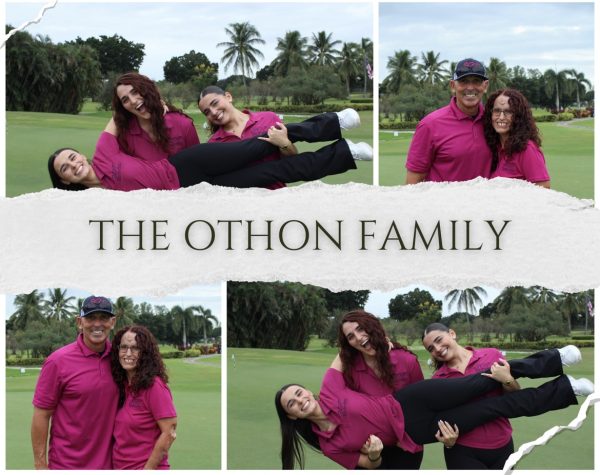
“Over the years, it’s become a fight for every single breath,” says Sara Othon.
As the youngest daughter of three, Juliette was just a newborn when her mother’s life was altered completely. Juliette, being deeply family-oriented, has made a grand impact on her life as she watched the woman who raised her endure such arduous struggles.
“Over the years, I’ve learned from her quiet strength and resilience,” she says. “It made me realize that strength isn’t always loud, but in the moments you keep going, even when it feels impossible.”
Having a disabled parent could also force a mature side of a child to show quicker. Typically, it’s normal to see the dynamic of the parent constantly taking care of their child. When the roles are reversed, and the caretaking falls into younger hands, it can alter the kid’s perspective drastically.
More than five million children under 18 act as caregivers for a family member. Early independence and a developed mind are often the result of a child growing up in this sort of household.
“They [Juliette’s older sisters] were so young themselves, but they showed up in ways I can’t even describe,” Juliette states. “It was like they grew up overnight.”
Some parents obtain their disability later in life. Whether a child sees the drastic change from their parent’s pre-disabled to post-disabled life or even a lifelong case, you grow to comprehend lessons along the way. Certain traits about yourself, a parent, and even a sibling tend to reveal themselves.
“I’ve learned how resilient people actually are when life forces them to change. My mom had to grieve the life and career she built, and I had to learn what empathy really looked like, not just feeling bad for someone, but understanding their losses and adapting with them,” comments Anne Abramovi.
Anne Abramovi is currently a law student and a Pembroke Pines Charter High School (PPCHS) alumna. Abramovici’s mother, Ivonne Abramovici, has lived with chronic shoulder impairment for the last 15 years. Mrs. Abramovici was forced to step away from her role in the surgical field because of this disabling condition.
Financial challenges can also prevail. Because of disabilities, a person’s ability to work could be eliminated, resulting in a loss of a stable income for the entire family. While parents carry the financial burden, the child frequently suffers from the notion of helplessness. Not being able to help with medical bills, basic needs, and everything in between leaves a lasting mark.

Despite many negative outlooks, there’s always a positive. One family member having an optimistic angle can be a backbone for the family. This perspective was embraced by Pablo Moreno. Moreno is a work-from-home father to two PPCHS students. He was raised by his aunt, Patricia Lozano, and grandmother, Juana Lozano, who were both diagnosed with arthritis.
“It was inspiring to see how, even in the toughest of times when they were in such pain, they put their best foot forward to make sure my sister and I were okay,” Moreno says.
Everybody who has lived a life in the company of a parent with a disability has at least one lasting takeaway. As for myself, having a mom with rheumatoid arthritis and anxiety has been the most formative experience I’ve ever been through. While I reflect, I realize many traits I own were built by that childhood: my patience, fast-paced maturity, sensitivity, and responsibility all sprouting faster than normal.
I have always been a firm believer in the saying “everything happens for a reason,” but I couldn’t quite wrap my head around why my mother had to go through such pain every day. After countless sleepless nights, praying for healing, and desperate answers, it suddenly became clear. I recognize deep down that living in this shadow of pain has not only shaped her but also who I am today in the best way possible. My heart was being structured by traits of strength all along.





Patricia Lozano • Jan 26, 2026 at 6:01 PM
Awesome article. Nia Moreno is my beautiful niece., who has lived and seen how debilitating Rheumatoid Arthritis has affected us Mariel Villaman( her mother) and myself Patricia Lozano (auntie) for many years. She is an inspiration. God bless her and all those who are dealing with a disabled parent.